Royal Brougham
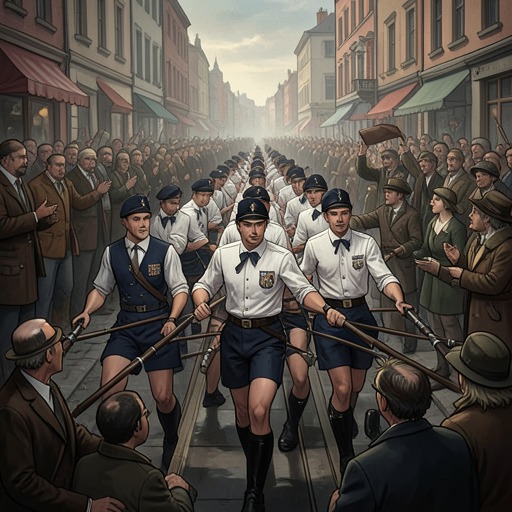
The Boys in the BoatRoyal Brougham was the sports editor at the Seattle Post-Intelligencer and a persistent promoter of Washington rowing. Across decades of reporting, he worked to turn a western university crew into a source of civic pride and national attention. His role reached beyond recording races: he questioned coaches, backed crews he believed were being overlooked, and gave their performances a public language of hope, anxiety, and triumph.
Identity and Public Role
Brougham had worked at the paper since 1910 and became a familiar figure in civic life. His reputation rested on tenacity, connections, and an ability to draw information from prominent people. Politicians, athletes, university presidents, coaches, and others sought him out; his influence made him more than a reporter who filled a daily column. He was also an energetic promoter, above all of the city itself, which he wanted the wider world to see as more sophisticated and consequential than a gray logging and fishing town.
That ambition shaped his interest in the University of Washington crew. When Brougham arrived at the paper, its rowing program was small and rough-edged, with country boys training in leaky shells under Hiram Conibear. The program had since advanced, but still received limited respect outside the West Coast. Brougham saw a successful crew as a means for both the university and the city to gain recognition. Rowing offered prestige as well as competition, and he treated the team's fortunes as part of a larger effort to change how the region was regarded.
His manner combined persistence with a sense of performance. In one early encounter with Al Ulbrickson, Brougham edged close while the coach watched freshmen on a ramp beside the Cut and pressed him for his judgment of the new crop. He knew Ulbrickson's enduring solemnity, and had nicknames for the coach's stony expression. Ulbrickson waited before answering, while Brougham kept probing. The scene captures a recurring relationship: the reporter sought a revealing assessment, while the coach offered little readily and guarded his thoughts.
Building a Western Rowing Story
Brougham's campaign took place against a sport whose public profile was growing. Collegiate rowing drew large crowds and substantial press attention in the 1920s and 1930s, while eastern colleges and their traditions held much of the sport's prestige. In the West, the University of Washington and California crew met in a rivalry dating to 1903. Their annual races drew students, alumni, and citizens, but the programs had struggled for recognition and resources, and western crews mostly competed against one another. Brougham's coverage helped make that regional contest legible as a question of national standing.
The Intercollegiate Rowing Association regatta at Poughkeepsie represented a larger proving ground. Eastern colleges had long dominated it; western participation began tentatively, with Stanford placing sixth in 1912 and Washington's first varsity crew reaching third in 1913. Such results unsettled eastern expectations without yet securing lasting recognition. For Brougham, the contrast between western progress and eastern prestige gave every later appearance at Poughkeepsie added significance. A race there could test the crew on the water and challenge assumptions about where first-rate rowing belonged.
He also made the athletes' experiences part of the public story. When the Washington boys reached a new place near the water, their attention turned quickly to a cookhouse only twenty-five feet from their front door. Evanda May Calimar was in charge, preparing lunch with members of her family. Brougham watched the crew's first meal and sent a story home; the paper ran it beneath a photograph of Joe Rantz with a caption identifying him as the eating champion. The episode shifted the focus from race results to the boys' daily life, while making Rantz a recognizable figure to readers.
Championing the Sophomores
Brougham repeatedly backed Washington's sophomore oarsmen, even when their performances were uneven. After their freshman success at Poughkeepsie, George Varnell of The Seattle Times wrote that the group might supply an Olympic lineup in 1936. Ulbrickson generally discouraged the crew from reading sports coverage during the school year, but the favorable summer reports gave the young rowers reason for confidence. Brougham's attention helped keep their promise in view before the coach had settled on their place in the senior crew.
The issue became especially pointed when coaches rearranged their boats. At the Pacific Coast Regatta, Ky Ebright had demoted the California varsity that had won the previous year's national title, replacing it with a mixed boat of sophomores and junior-varsity oarsmen. When Brougham arrived in Oakland, Ebright asked him to explain why the former champions could not out-row the younger combination. Brougham could not account for the reversal, but the question itself reflected how closely he tracked the reshaping of crews and how readily coaches treated him as a conduit for their concerns.
Brougham also watched the Washington trials for signs that the sophomores' rough starts concealed stamina. In the two- and three-mile trials, they initially flailed and allowed older rowers to move ahead, but appeared to settle after the first mile. The older crew, by contrast, began to look ragged late in the longer trial. Brougham had supported the sophomores for months, notwithstanding their recent sloppiness, and the late-race contrast strengthened his case. When the favored group later rowed smoothly through the remaining mile and a half, passed Navy, and finished two lengths ahead, he celebrated their victory on the radio. Ulbrickson maintained that the sophomores would not have placed in the varsity race, citing the greater size and power of its field; Brougham continued to point to how fresh the younger rowers had looked at the finish.
Reporting Triumph and Uncertainty
Brougham's advocacy did not mean unbroken optimism. Before the 1936 Poughkeepsie varsity race, he considered the eastern press's preference for California and Cornell, the bookmakers' close odds on California and Washington, and the uncertain outcome of a race delayed until after sundown by the tides. He gathered details around town before the late start. Even when he personally predicted a Washington victory, his coverage acknowledged how narrow the contest appeared and how much remained undecided.
At another critical stage, he warned readers not to forget the danger of the final mile. Washington had given supporters cause for excitement, but Brougham had witnessed the disappointment that followed high hopes the year before. His caution preserved the distance between potential and achievement. The crews still had to convert speed into a finish, and he understood that an early lead or a promising display did not settle a race.
When Washington's varsity finally won a dramatic, come-from-behind race at Poughkeepsie, Brougham struggled to find a description equal to what Bobby Moch had accomplished. Other sportswriters praised the victory as historic, brilliant, or unprecedented; Brougham's chosen characterization emphasized Moch's composure under pressure. The boat's result, and the intelligence behind it, had become the story he had spent years trying to bring within reach: Washington was now a national champion, and its crew had swept the Hudson.
The same commitment connected his reporting to the city's support for the Olympic campaign. After a meeting about the funding shortage, Brougham conferred with Ulbrickson and Varnell, and they began preparing headlines and special columns for their respective papers. Civic leaders soon started organizing a fundraising effort in the Washington Athletic Club. Ulbrickson tried to keep the athletes from worrying about the money; the press work, by contrast, made the problem visible to a wider public and helped turn the team's need into a civic undertaking.
Olympic Victory and Unprinted Story
Brougham followed the crew's Olympic campaign to its final victory. As the boys rowed slowly past the grandstands to polite applause, he hurried to the press room and began writing what he considered the sports story of his career. His search for words unfolded alongside an event beyond the race: the news writers' guild had established picket lines around the Seattle Post-Intelligencer offices. The paper would not publish the next morning, and Brougham's account would never appear in print.
The failure of publication did not end his association with the crew's history. At Poughkeepsie the next day, he watched the eight oarsmen shake hands quietly and leave by separate paths. His account of their departure treated the moment as the close of a remarkable combination. Across his career, Brougham had helped make Washington rowing visible through sustained coverage, personal advocacy, and a reporter's instinct for the meaning surrounding a race. At the decisive moment, however, the story he had worked toward could not reach its readers in his own newspaper: the crew's achievement outlasted the printed account that the strike prevented.